Free daily practice for people who build AI agents.
Find the bug in today's AI agent. Then fix it, and run it for real.
One broken agent a day, drawn from the 21 agentic design patterns. Tap the line where it breaks, write the fix, watch a real model run it. Developer and product manager tracks. Free, no sign up to start.
| 1 | Read the broken trace and tap the line where it goes wrong. |
| 2 | Write the fix. A hint asks you questions; it never writes it for you. |
| 3 | Run it against a real model and see whether it holds. |
Today's broken agent
Live. Tap a line to start.
About ten minutes. Your progress is kept, with or without an account.
- 21
- developer patterns, each mapped to a software concept you already know
- 15
- product manager modules, no code
- 1 a day
- broken agent to find and fix, graded by a real model run
- Free
- no account needed to start, a free one keeps your progress
Pick your track
Same challenges, two ways to read them
Developer
21 agentic design patterns, each mapped to a software engineering idea you already know: prompt chaining is pipe and filter, reflection is test driven development, tool use is the adapter pattern. Each one has a definition, before and after code, production notes, and a broken agent to fix.
Browse the 21 patterns7 open without an account
Product manager
15 decision modules with no code: what each pattern does, what it costs, what breaks, and what to ask your engineering team. In the daily challenge you read the same broken trace and name the failure mode and the number that would have caught it.
Browse the 15 modulesfirst module open without an account
> What people are saying
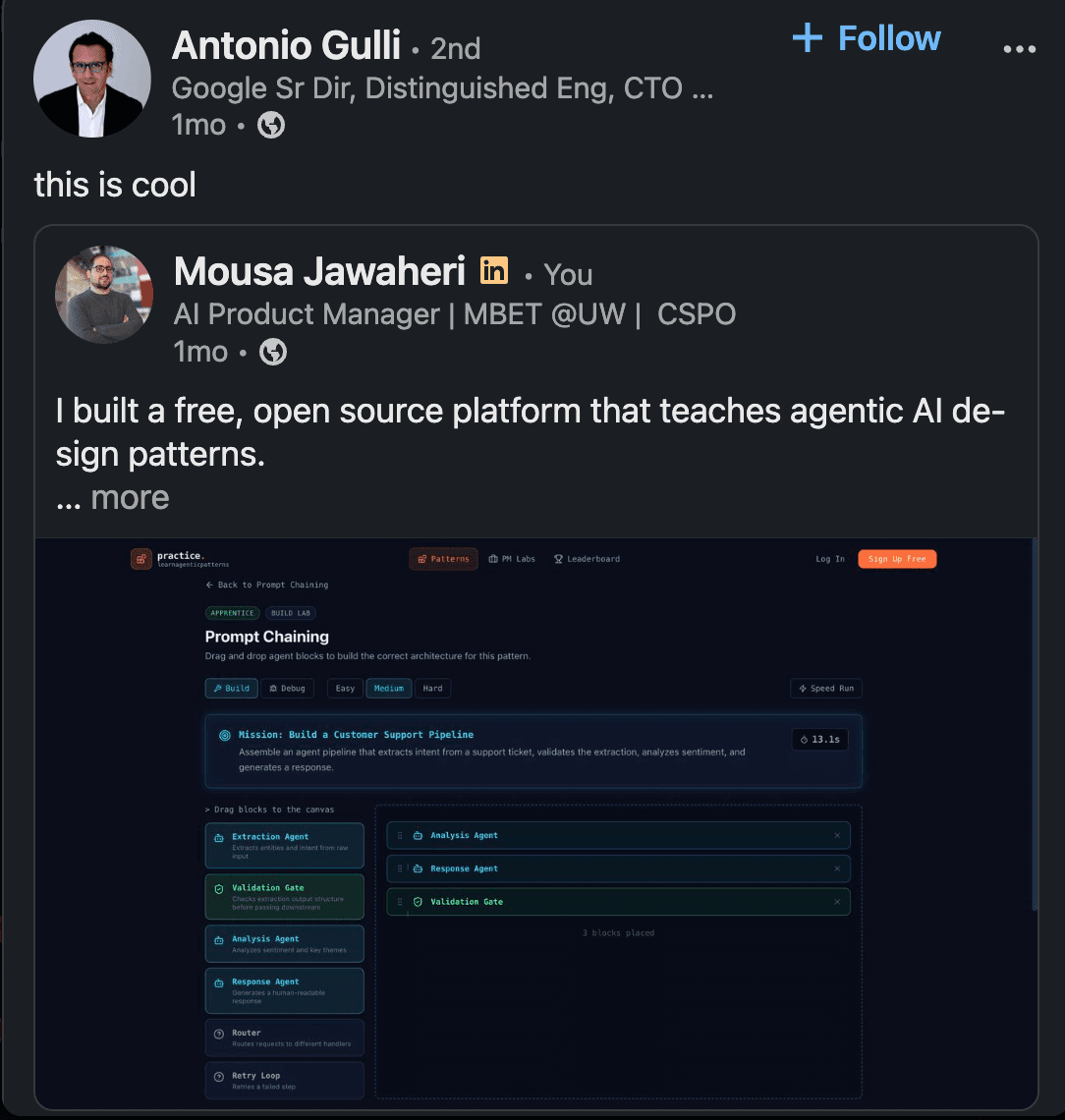
Antonio Gullí
Sr Director, Distinguished Engineer, CTO at Google
Author of “Agentic Design Patterns: A Hands-On Guide to Building Intelligent Systems.” The 21 patterns this curriculum is built on.
Everything in the curriculum, 36 lessonsshow
Contents
The full curriculum
Two tracks, 36 lessons, all free. Seven patterns and the first PM module are open without an account; a free account unlocks the rest.
- 01Prompt Chaining
- 02Routing
- 03Parallelization
- 04Reflection
- 05Tool Use
- 06Planning
- 07Multi-Agent Collaboration
- 08Memory Management
- 09Learning & Adaptation
- 10State Management (MCP)
- 11Goal Setting & Monitoring
- 12Exception Handling & Recovery
- 13Human-in-the-Loop
- 14Knowledge Retrieval (RAG)
- 15Inter-Agent Communication (A2A)
- 16Resource-Aware Optimization
- 17Reasoning Techniques
- 18Guardrails & Safety
- 19Evaluation & Monitoring
- 20Prioritization
- 21Exploration & Discovery
- 01Becoming AI-Native
- 02AI Product Discovery
- 03The PM Prototyping Toolkit
- 04Task Orchestration
- 05Intelligent Routing
- 06Speed & Parallel Processing
- 07Quality & Self-Correction
- 08RAG & Knowledge Systems
- 09Tools, APIs & MCP Integrations
- 10Multi-Agent Teams
- 11Memory & Personalization
- 12Safety, Guardrails & Human Oversight
- 13Measuring Agent Success
- 14LLMOps & Production Realities
- 15Your Agentic AI Roadmap
Common Questions
Software that uses a language model to plan, call tools and act on its own toward a goal, instead of answering one prompt at a time. Building it well is architecture: the same 21 design patterns come up in every framework. This site teaches those patterns and makes you fix broken agents built with them.
Yes. The daily challenge, 7 developer patterns and the first PM module are open without an account. A free account, no card, unlocks all 21 patterns, all 15 modules, and keeps your XP and streak.
No. The developer track assumes you already ship software: APIs, distributed systems, production code. The PM track assumes you own or influence product decisions. Both start from what you know and add the agent layer.
No. The PM modules and the PM version of each challenge are code free. You read the same broken trace a developer reads, name the failure mode, and say what you would measure.
They teach a product. This teaches the layer between them: which pattern to use and why, framework agnostic, with pseudocode and examples from LangChain, LangGraph, CrewAI and AutoGen. And it makes you practise every day on a real broken agent, graded by a real model run.
Not sure where to start? Take the three minute assessment or sign up free.